
Your BMI (Body Mass Index) is your weight in kilograms divided by your height in meters squared: BMI = weight (kg) ÷ height (m)². For example, a person who weighs 70 kg and is 175 cm tall has a BMI of 22.9 — inside the normal range of 18.5 to 24.9 set by the World Health Organization (WHO).
This guide covers the formula, worked examples, the complete BMI chart, healthy weight ranges for common heights, and — just as important — what BMI cannot tell you. You can skip the arithmetic entirely with the free BMI calculator, which needs only your weight in kg and height in cm.
What Is BMI?
Body Mass Index is a screening number that relates your weight to your height. It was designed as a quick, population-level tool, which is why doctors, fitness apps and insurance forms still use it as a starting point for discussing weight-related health.
BMI is not a diagnosis and it does not measure body fat directly. It is a single data point that becomes meaningful alongside others — waist circumference, blood pressure, activity level and diet. Its full background is covered in the Wikipedia article on Body Mass Index.
The BMI Formula, Step by Step
The formula has three steps:
- Convert your height to meters (divide centimeters by 100).
- Square that number (multiply it by itself).
- Divide your weight in kg by the result.
Worked example 1 — normal. Weight 70 kg, height 175 cm. Height in meters: 1.75. Squared: 1.75 × 1.75 = 3.0625. BMI = 70 ÷ 3.0625 = 22.9 → normal.
Worked example 2 — overweight. Weight 85 kg, height 170 cm. Height squared: 1.70 × 1.70 = 2.89. BMI = 85 ÷ 2.89 = 29.4 → overweight, close to the obese boundary.
Worked example 3 — underweight. Weight 52 kg, height 168 cm. Height squared: 1.68 × 1.68 = 2.8224. BMI = 52 ÷ 2.8224 = 18.4 → just below the normal range.
The BMI Chart: WHO Categories
Every adult BMI result falls into one of four standard categories defined by the WHO:
| BMI | Category |
|---|---|
| Below 18.5 | Underweight |
| 18.5 – 24.9 | Normal weight |
| 25.0 – 29.9 | Overweight |
| 30.0 and above | Obese |
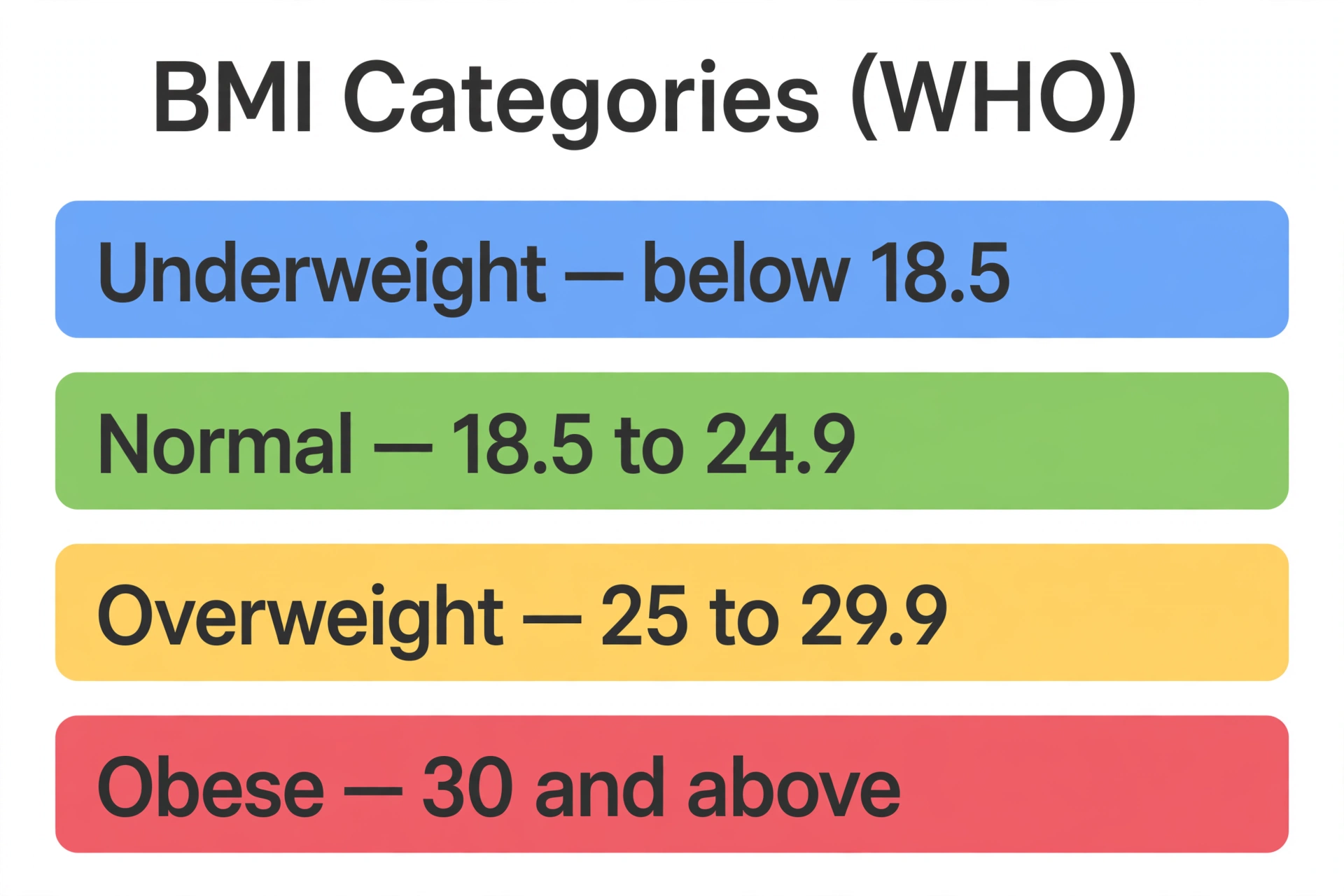
One adjustment matters for readers in Pakistan and the rest of South Asia. A WHO expert consultation identified lower public-health action points for Asian populations — increased risk from a BMI of 23 and high risk from 27.5 — because health risks at a given BMI tend to be higher. The standard chart above is still the official classification, but if you are South Asian, treat 23 as an early-warning line rather than waiting for 25.
What Is a Healthy Weight for Your Height?
Turning the formula around gives the weight range that keeps you in the normal BMI band (18.5–24.9) at your height:
| Height | Healthy weight range |
|---|---|
| 160 cm (about 5′3″) | 47.4 – 63.7 kg |
| 165 cm (about 5′5″) | 50.4 – 67.8 kg |
| 170 cm (about 5′7″) | 53.5 – 72.0 kg |
| 175 cm (about 5′9″) | 56.7 – 76.3 kg |
| 180 cm (about 5′11″) | 59.9 – 80.7 kg |
If your height is usually measured in feet and inches, convert first: 5′2″ = 157.5 cm, 5′4″ = 162.6 cm, 5′6″ = 167.6 cm, 5′7″ = 170.2 cm, 5′8″ = 172.7 cm, 5′10″ = 177.8 cm, 6′0″ = 182.9 cm. (One inch is exactly 2.54 cm.)
How to Check Your BMI with the Online Calculator
The ToolHost BMI calculator does the formula for you:
- Enter your weight in kilograms.
- Enter your height in centimeters (use the conversions above if you know it in feet and inches).
- Read your result — your BMI number and its WHO category, instantly.
The calculation runs entirely in your browser; your weight and height are never stored or transmitted anywhere.
What BMI Does Not Tell You
BMI’s simplicity is also its weakness. It cannot see:
- Muscle mass. Muscle is denser than fat, so a trained athlete or bodybuilder can score “overweight” or even “obese” with low body fat.
- Fat distribution. Weight carried around the waist carries different risks than the same weight elsewhere; BMI ignores this completely.
- Age and life stage. The categories were developed from adult studies, so they apply less precisely to children, teenagers, pregnant women and the elderly.
- Bone density and build. Naturally larger frames score higher without carrying excess fat.
Use BMI as a screening signal, not a verdict. A result outside the normal band is a reason to look closer — ideally with a doctor — not a reason to panic or to crash-diet.
How to Move Toward a Healthy BMI
Small, steady changes move the number because BMI responds directly to weight at a fixed height:
- Know your range first. Use the table above to find the normal weight band for your height, then aim for its middle, not its edge.
- Change one habit at a time. Replacing one sugary drink a day, or adding a 30-minute walk, is sustainable in a way that extreme diets are not.
- Recheck monthly, not daily. Weight fluctuates with water and meals; a monthly BMI check shows the real trend. Measure the same way each time — same scale, similar time of day — so the numbers stay comparable.
If your BMI is below 18.5 or above 30, or you have any existing condition, talk to a qualified doctor before starting a weight-change plan. This guide is information, not medical advice.
How to Measure Yourself Correctly for BMI
A careless measurement can shift your BMI by a full point, so take thirty seconds to do it right.
- Height: stand barefoot against a wall, heels and back touching it, head level. Mark the top of your head and measure to the floor. Shoes or thick socks can add 2–3 cm that you do not actually have.
- Weight: use a hard, flat floor (not carpet), step on the scale in light clothing, and weigh yourself in the morning before breakfast for the most consistent reading.
- Be consistent: for repeat checks, always measure under the same conditions — same scale, same time of day. Trends measured consistently are far more trustworthy than any single reading.
Frequently Asked Questions
What is a normal BMI?
For adults, a BMI between 18.5 and 24.9 is classified as normal weight by the WHO. Below 18.5 is underweight, 25 to 29.9 is overweight, and 30 or above is obese.
How do I calculate BMI if I know my height in feet and inches?
Convert your height to centimeters first — total inches × 2.54 — then use the standard formula, or simply enter the cm value into the BMI calculator. Example: 5′7″ is 67 inches, which is 170.2 cm.
Is BMI accurate for athletes and bodybuilders?
Not very. BMI cannot distinguish muscle from fat, so muscular athletes often score in the overweight or obese bands despite low body fat. For them, waist circumference and body-fat measurements are more informative.
What is a healthy weight for someone 5′7″ tall?
5′7″ is about 170 cm, so the healthy weight range is roughly 53.5 to 72.0 kg — the range that produces a BMI of 18.5 to 24.9 at that height.
Is my data saved when I use the BMI calculator?
No. The ToolHost BMI calculator runs entirely in your browser using JavaScript. Your weight and height are never uploaded, stored or transmitted.
Check Your BMI Now
Two numbers — weight in kg, height in cm — are all it takes. Open the free BMI calculator and see where you stand in seconds.