
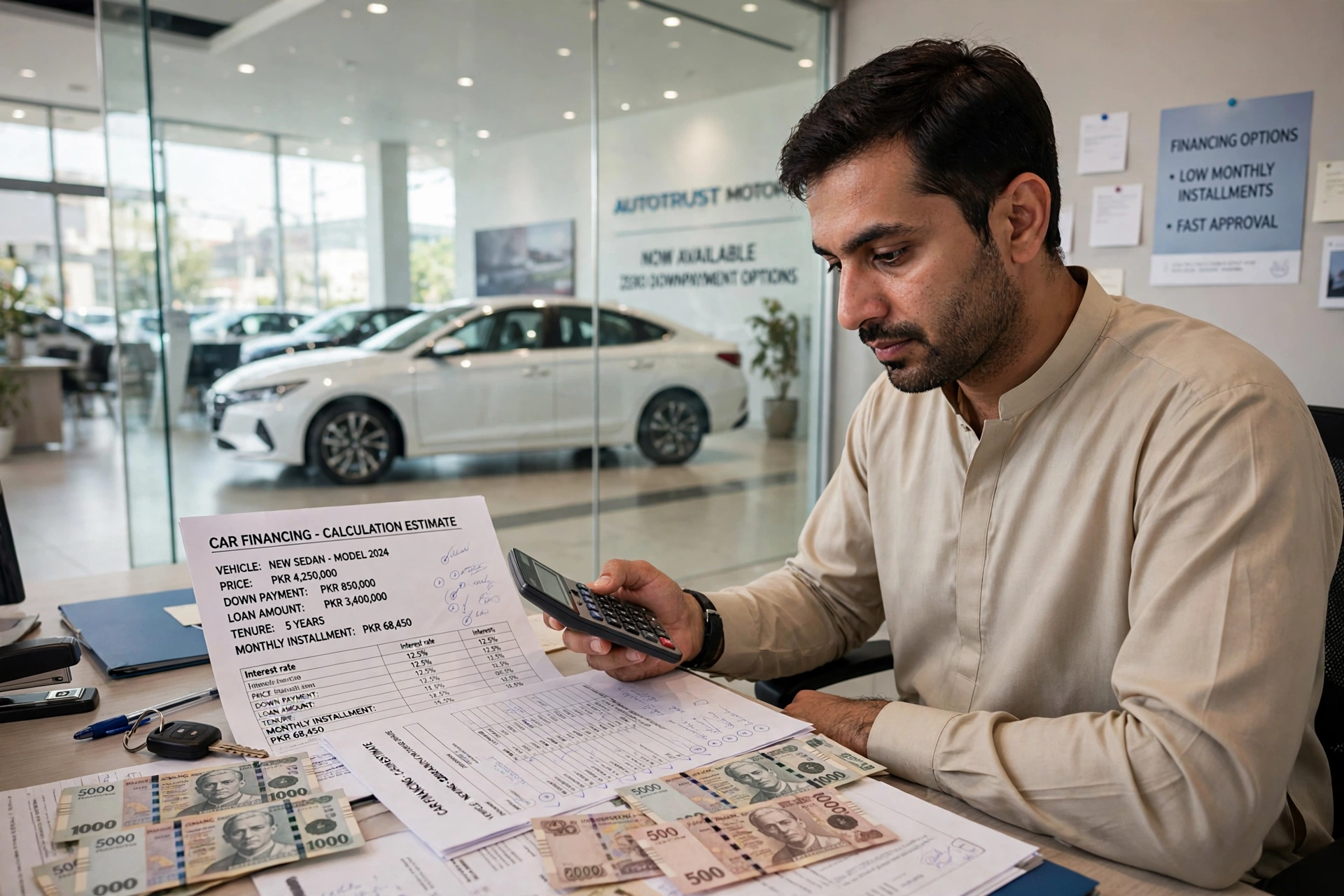
An EMI calculator Pakistan borrowers open before signing anything exists for one reason: in Pakistan, a loan costs far more than the amount you borrow. With the State Bank’s policy rate at 11.5% (October 2026) and most bank loans priced at KIBOR plus a spread, the monthly instalment — not the loan amount — is the number that decides whether a car, house or personal loan actually fits your life. This guide shows exactly how that instalment is calculated, with worked examples in rupees, and links to our free EMI Calculator that does the maths in seconds.
How to Use the EMI Calculator (30 Seconds)
- Open the free EMI Calculator.
- Enter the loan amount — what you actually borrow, after your down payment.
- Enter the annual interest rate your bank quoted (for KIBOR-linked loans, add KIBOR and the bank’s spread together).
- Enter the tenure in months — 36 for 3 years, 60 for 5 years, 240 for 20 years.
- Read your monthly EMI and the total interest side by side. The calculation runs in your browser — nothing is saved or sent anywhere.
What Is an EMI — and the Formula Banks Use
EMI stands for Equated Monthly Instalment: the fixed amount you pay every month until the loan ends. Every EMI is part principal (the money you borrowed) and part interest. Pakistani banks use the standard reducing-balance formula:
EMI = P × r × (1+r)n ÷ ((1+r)n − 1)
where P is the loan amount, r is the monthly rate (annual rate ÷ 12 ÷ 100), and n is the number of monthly payments. “Reducing balance” means interest is charged only on what you still owe — so in the first year most of each instalment is interest, and towards the end most of it is principal. That single fact explains almost everything below.
Worked Example — A Rs 20 Lakh Car Loan
Suppose you finance Rs 2,000,000 for a car at 17% per year — a realistic KIBOR-plus-spread rate in 2026. Watch what the tenure alone does to the cost:
| Tenure | Monthly EMI | Total interest | Total you repay |
|---|---|---|---|
| 3 years | Rs 71,305 | Rs 566,996 | Rs 2,566,996 |
| 5 years | Rs 49,705 | Rs 982,309 | Rs 2,982,309 |
| 7 years | Rs 40,872 | Rs 1,433,215 | Rs 3,433,215 |
Read the last two rows carefully. Stretching the loan from 5 to 7 years lowers your monthly payment by only Rs 8,833 — but adds Rs 450,906 in extra interest. On a 7-year plan you hand back over Rs 14 lakh in interest on a Rs 20 lakh loan. This is why comparing tenures in the EMI Calculator matters more than negotiating the EMI down a few hundred rupees.
EMI Examples for Other Loans in Pakistan
Personal loan: Rs 500,000 at 24% for 3 years → EMI of about Rs 19,616, and total interest of about Rs 206,191 — over 41% of the amount borrowed, in just three years. Personal loans are the most expensive common borrowing in Pakistan, which is why their rates (typically 20–28%) deserve the hardest look.
Home loan: Rs 5,000,000 at 19% for 20 years → EMI of about Rs 81,034. The sobering part: total interest comes to roughly Rs 1.44 crore — nearly three times the amount borrowed — and you repay about Rs 1.94 crore in all. Long tenures make big loans survivable month to month, but the interest mountain is real. Even a slightly shorter tenure or a larger down payment cuts it dramatically — test it in the calculator.
Typical Loan Rates in Pakistan (October 2026)
Most conventional bank pricing in Pakistan is built as KIBOR + spread: the 1-year KIBOR stood at about 12.75% in mid-October 2026, and each bank adds its own margin. Typical ranges right now:
| Loan type | How it is priced | Typical range |
|---|---|---|
| Car financing | 1-year KIBOR + 3.5–4.5%, or fixed promos | ≈ 16–22% per year |
| Personal loans | Fixed, unsecured | ≈ 20–28% per year |
| Home financing | Mostly KIBOR-linked, floating | ≈ 17–24% per year |
Your actual offer depends on the bank, your salary and employer, your credit history (eCIB) and whether you are a tax filer. Islamic banks (Ijarah and Diminishing Musharakah) price their monthly rentals off the same KIBOR benchmarks, so the monthly figures land in a similar range. Two State Bank rules worth knowing: total auto financing is capped at Rs 3 million per person across all banks, and lenders check that your total instalments stay within roughly 40% of your net income (the debt-burden ratio).
Fixed vs Floating — Why Your EMI Can Change
A fixed-rate loan keeps the same EMI from first month to last. A floating (KIBOR-linked) loan is repriced when KIBOR moves — if the State Bank cuts the policy rate, your instalment falls; if it hikes, your instalment rises, sometimes mid-loan. Neither is automatically better: fixed gives certainty, floating gives you the benefit when rates fall (as they have been from their peak). What matters is that you run the numbers at today’s rate and at 2% higher, and make sure both still fit your budget.
5 Ways to Reduce Your EMI and Total Interest
- Increase the down payment. Every rupee you pay upfront is a rupee you never pay interest on. On cars, banks typically require 15–30% equity anyway — paying more than the minimum is the cheapest “discount” available.
- Choose the shortest tenure you can truly afford. The car-loan table above shows why: tenure is the biggest interest lever you control.
- Compare spreads, not just banks. KIBOR is the same for everyone — the spread is where banks differ. A 1% lower rate on Rs 20 lakh over 5 years saves roughly Rs 64,000 in interest. Get quotes from 3–4 banks.
- Count the extras separately. Processing fees, insurance/takaful and car trackers sit outside the EMI. A “lower EMI” offer loaded with fees can cost more overall.
- Prepay when you can. Even occasional extra principal payments shrink the balance that interest is charged on. Check your agreement for prepayment penalties first — they vary by bank and product.
Frequently Asked Questions
How much EMI can I afford? Use the debt-burden guideline Pakistani banks apply: all your loan instalments together should stay within about 40% of your net monthly income. If your take-home pay is Rs 200,000, total instalments above roughly Rs 80,000 will strain the budget — and the bank’s approval.
Does the EMI include insurance and processing fees? No. The EMI from this calculator — like the bank’s own EMI quote — is principal and interest only. Processing fees, insurance/takaful premiums and tracker charges are billed separately, so ask for them in writing before comparing offers.
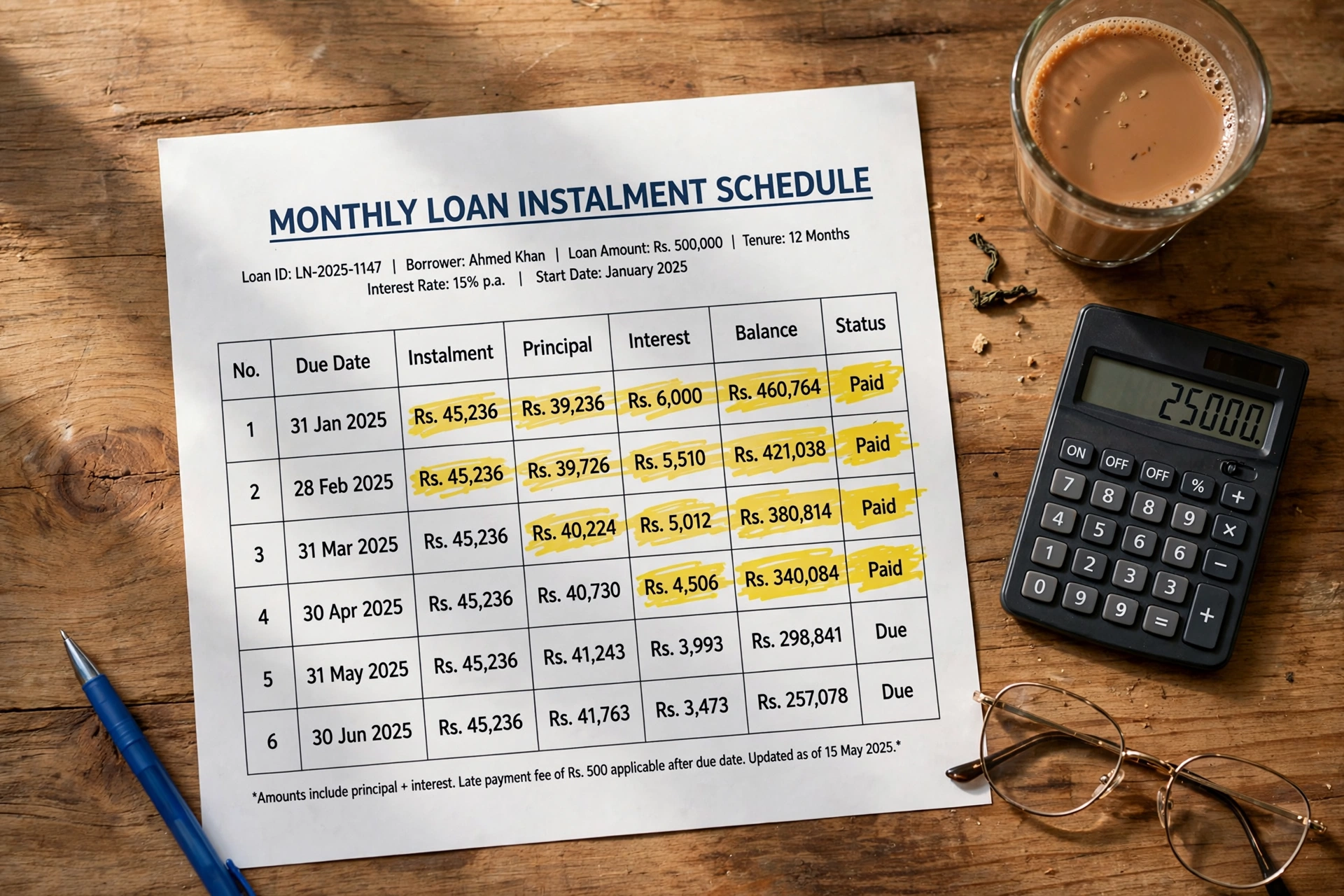
Why is most of my early instalment just interest? Because interest is charged on the outstanding balance, which is highest at the start. As the balance falls, the interest share of each EMI shrinks and the principal share grows — exactly what the schedule image above shows.
Can I use this calculator for Islamic financing? Yes, as a close estimate. Ijarah and Diminishing Musharakah rentals are scheduled much like EMIs; enter the total financing amount, the bank’s profit/rental rate and the tenure. The bank’s own schedule remains the final word.
What is the difference between a flat rate and a reducing-balance rate? Some dealers quote a tempting “flat” rate, where interest is charged on the original amount for the whole tenure — that makes the true cost far higher than the same number on a reducing balance. Always compare loans on the reducing-balance EMI, which is what this calculator (and bank financing) uses.
Final Words
A loan is not expensive or cheap because of its EMI alone — it is the total interest that decides. Before you sign anything, open the free EMI Calculator, run your exact amount at two or three tenures, and compare the totals. Planning the savings side too? Our Compound Interest Calculator shows what the same monthly amount could grow into instead — and the Percentage Calculator helps with the rate maths in between.
Disclaimer: This guide is for education and estimation only, using typical rates available in October 2026. Rates, spreads and bank policies change; always confirm the final figures, fees and terms with your bank before signing.