
Color Analysis: Find the Colors That Suit You Best
Choosing the right colors can make a noticeable difference in how your clothes, makeup, hair colors, and overall appearance look. But with thousands of colors available, it can be difficult to know which shades actually complement you.
Color analysis is a method of identifying colors that work well with your natural features, particularly your skin tone, undertone, hair color, and eye color. It can help you build a more coordinated wardrobe and choose colors with greater confidence.
In this guide, we’ll explain what color analysis is, how it works, the difference between skin tone and undertone, seasonal color analysis, and how you can use color palettes to make better color choices.
What Is Color Analysis?
Color analysis is the process of determining which colors harmonize best with a person’s natural coloring.
The analysis commonly considers:
- Skin tone
- Skin undertone
- Natural hair color
- Eye color
- Contrast between facial features
- Warm, cool, or neutral characteristics
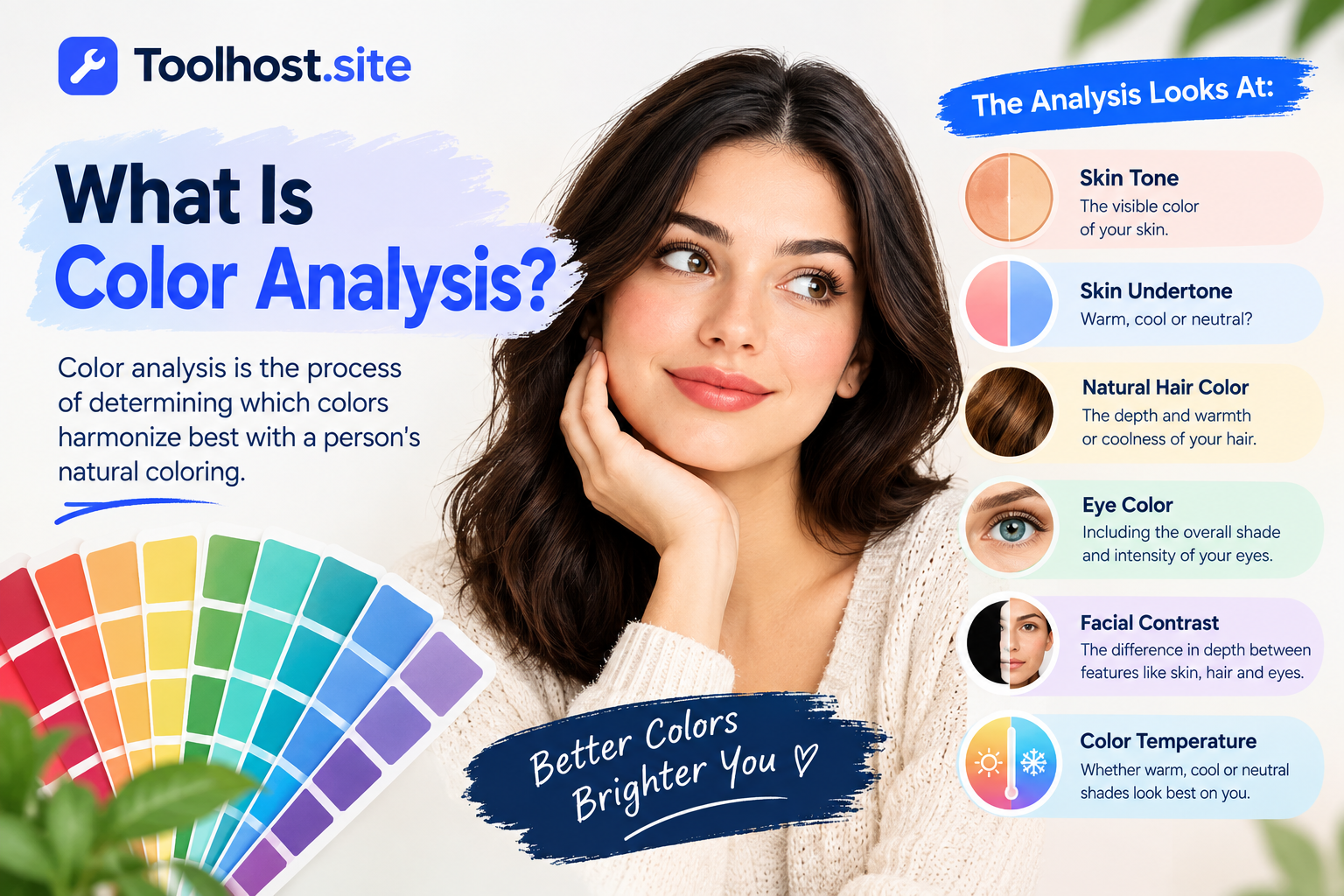
The goal is not to say that certain colors are completely off-limits. Instead, color analysis helps identify shades that may complement your natural coloring more effectively.
For example, someone with a cool undertone may find that blues, cool pinks, and jewel tones complement their appearance, while someone with a warm undertone may prefer earthy shades such as olive, camel, warm beige, or terracotta.
Why Is Color Analysis Useful?
Understanding your personal color palette can make everyday color decisions easier.
It can help when choosing:
- Clothes
- Accessories
- Makeup shades
- Hair colors
- Jewelry
- Personal branding colors
- Profile photos
- Website and design colors
A suitable color can sometimes make your complexion appear more balanced, while a less harmonious shade may create stronger contrast or make certain features appear less noticeable.
Color analysis is therefore useful not only for fashion but also for anyone interested in personal style and visual appearance.
Skin Tone vs. Skin Undertone
One of the most important concepts in color analysis is understanding the difference between skin tone and skin undertone.
Skin Tone
Skin tone describes the surface color of your skin. It can generally range from:
- Very fair
- Fair
- Medium
- Tan
- Deep
Skin tone can change because of sun exposure, tanning, or other factors.
Skin Undertone
Your undertone is the subtle color beneath the surface of your skin. It is generally classified as:
- Warm
- Cool
- Neutral
Unlike surface skin tone, your undertone tends to remain relatively consistent.
This distinction matters because two people can have similar skin tones but different undertones and may therefore look better in different color families.
How to Determine Your Undertone
There is no single test that works perfectly for everyone, but several commonly used methods can provide useful clues.
1. Look at Your Veins
Check the veins on the inside of your wrist under natural light.
- Greenish veins may suggest a warm undertone.
- Bluish or purplish veins may suggest a cool undertone.
- A mixture can indicate a neutral undertone.
This method is only a guideline because lighting and skin characteristics can affect how veins appear.
2. Compare Gold and Silver
Try wearing gold and silver jewelry and compare how they look against your skin.
If gold appears more harmonious, you may have a warm undertone.
If silver appears more harmonious, you may have a cool undertone.
If both look good, you may have a neutral undertone.
3. Try Different White Shades
Compare pure white with warmer off-white or cream fabrics in natural daylight.
If pure white looks particularly harmonious, a cool undertone may be worth considering. If cream or ivory appears more natural, you may lean warm.
Again, this is an indication rather than a definitive test.
What Is Seasonal Color Analysis?
Seasonal color analysis is one of the most popular approaches to personal color analysis.
The traditional system divides colors into four broad seasons:
Spring
Spring palettes generally emphasize warm, fresh, and relatively bright colors.
Common examples include:
- Peach
- Coral
- Warm yellow
- Light green
- Warm turquoise
Summer
Summer palettes generally feature cooler, softer, and more muted colors.
Examples include:
- Powder blue
- Dusty rose
- Lavender
- Soft gray
- Cool pink
Autumn
Autumn palettes commonly contain warm, rich, and earthy colors.
Examples include:
- Rust
- Olive
- Mustard
- Terracotta
- Warm brown
Winter
Winter palettes generally include cool, clear, and high-contrast colors.
Examples include:
- Black
- Pure white
- Emerald
- Royal blue
- Deep berry
Modern systems can divide these four seasons into additional categories, such as 12-season color analysis, to provide more detailed results.
What Is 12-Season Color Analysis?
The 12-season system expands the traditional four-season model by dividing each season into three subcategories.
For example:
- Spring → Light Spring, Warm Spring, Bright Spring
- Summer → Light Summer, Cool Summer, Soft Summer
- Autumn → Soft Autumn, Warm Autumn, Deep Autumn
- Winter → Deep Winter, Cool Winter, Bright Winter
This approach considers additional characteristics such as temperature, depth, brightness, and overall contrast.
It can be useful for people who feel that they do not fit neatly into one of the four traditional seasons.
Warm vs. Cool Colors
Another important part of color analysis is understanding color temperature.
Warm Colors
Warm colors usually contain yellow, orange, or golden characteristics.
Examples include:
- Orange
- Coral
- Warm red
- Mustard
- Golden yellow
- Camel
- Warm beige
Cool Colors
Cool colors generally contain blue, violet, or blue-based characteristics.
Examples include:
- Blue
- Lavender
- Cool pink
- Blue-red
- Emerald
- Cool gray
Some colors can have both warm and cool variations. Red, for example, can range from an orange-red to a blue-red.
This is why simply naming a color may not be enough. The exact shade can make a significant difference.
What Is a Color Palette?
A color palette is a group of colors designed or selected to work together.
A personal color palette might contain colors that complement your skin tone and overall appearance.
For example, a palette could include:
- Primary clothing colors
- Accent colors
- Neutral colors
- Jewelry colors
- Makeup-related shades
Digital designers use the same basic concept when creating websites, graphics, logos, and branding.
If you’re working with digital colors, you can also use a Color Palette Generator on Toolhost to experiment with coordinated color combinations.
Color Analysis for Clothing
Color analysis can be particularly useful when building a wardrobe.
Instead of buying clothes in random colors, you can identify a group of shades that work well together.
For example, a wardrobe palette might contain:
Base colors:
Black, navy, beige, brown, or gray
Accent colors:
Blue, green, red, pink, orange, or purple
Light colors:
Cream, white, pastel blue, or soft pink
The exact choices depend on your individual coloring and personal preferences.
The advantage of a consistent palette is that your clothes can become easier to mix and match.
Color Analysis for Makeup
Color analysis can also be applied to makeup.
Different undertones may influence which shades of:
- Foundation
- Blush
- Lipstick
- Eyeshadow
- Highlighter
appear most harmonious.
For example, warm coloring may pair well with peach, coral, bronze, or warm brown shades, while cool coloring may complement rose, berry, mauve, or cool pink shades.
However, makeup is highly personal, and product formulation, lighting, pigmentation, and individual preference can affect the result.
Color Analysis for Hair Color
Hair color is another area where color harmony can be useful.
Some people may find warm hair shades such as:
- Golden brown
- Warm caramel
- Copper
- Honey
work well with their coloring.
Others may prefer cooler shades such as:
- Ash brown
- Cool black
- Platinum
- Cool dark blonde
The best choice depends on your natural coloring, contrast level, and the overall appearance you want.
Can You Do Color Analysis Online?
Yes. Online color analysis tools and guides can provide a convenient starting point.
A digital color analysis may ask you to identify characteristics such as:
- Skin tone
- Undertone
- Eye color
- Hair color
- Preferred colors
Some services also analyze photographs.
However, photo-based analysis can be affected by:
- Indoor lighting
- Camera white balance
- Filters
- Makeup
- Image quality
- Screen settings
For this reason, online color analysis should generally be treated as a helpful starting point rather than an absolute rule.
Color Analysis vs. Color Palette Generator
These two concepts are related but serve different purposes.
Color analysis focuses on determining which colors may complement a person or a specific visual subject.
A color palette generator creates a collection of colors that work together based on a selected color or color relationship.
For example, personal color analysis may tell you that certain cool shades suit your coloring, while a palette generator can help you create a coordinated group of cool colors for a design project.
If you are working on a website, graphic, social media design, or branding project, Toolhost’s Color Palette Generator can help you experiment with monochromatic, analogous, complementary, and triadic color combinations.
How to Build Your Own Color Palette
You don’t necessarily need dozens of colors.
A simple personal or design palette can start with five colors:
- Main color
- Secondary color
- Accent color
- Light neutral
- Dark neutral
For example:
Main: Deep blue
Secondary: Blue-gray
Accent: Teal
Light neutral: Off-white
Dark neutral: Charcoal
You can then adjust the saturation and brightness until the colors feel balanced.
For digital projects, remember to record the HEX values of your selected colors so you can use exactly the same shades throughout your design.
Frequently Asked Questions About Color Analysis
What does color analysis mean?
Color analysis is a method of identifying colors that harmonize with a person’s natural features, such as skin tone, undertone, hair color, and eye color.
How do I know what colors suit me?
Start by identifying your skin undertone and observing how different warm, cool, light, and deep colors look against your natural appearance. Comparing colors in natural daylight can make the differences easier to see.
What are the 4 main color analysis seasons?
The four traditional seasons are Spring, Summer, Autumn, and Winter. Each represents a different combination of color characteristics such as warmth, coolness, brightness, softness, and depth.
What is the difference between skin tone and undertone?
Skin tone describes the visible surface color of your skin, while undertone refers to the subtle color beneath the surface. Undertones are commonly described as warm, cool, or neutral.
Can I do color analysis at home?
Yes. You can perform a basic color analysis at home by comparing different colors in natural daylight and observing which shades appear harmonious with your skin, eyes, and hair.
Is online color analysis accurate?
Online color analysis can provide useful guidance, but results may vary because photographs are affected by lighting, camera settings, filters, and screen displays.
What is a personal color palette?
A personal color palette is a selected group of colors that are intended to complement an individual’s natural coloring and make clothing, accessories, or styling choices easier.
Can a color palette generator help with color analysis?
A color palette generator can help you create and explore coordinated color combinations. It does not necessarily determine your personal seasonal color type, but it can be useful for experimenting with colors after you identify the shades you prefer.
Final Thoughts
Color analysis provides a practical way to understand how different colors interact with your natural appearance. By learning about skin undertones, color temperature, seasonal palettes, and color harmony, you can make more informed choices about clothing, makeup, hair, and personal style.
You don’t have to follow a color system rigidly. Use color analysis as a guide, experiment with different shades, and pay attention to the colors you personally enjoy.
For digital color combinations, you can also experiment with Toolhost’s Color Palette Generator to create and compare different palettes quickly.
Related Tool
Color Palette Generator — Toolhost
Create coordinated color combinations and copy HEX color codes directly from your generated palette.